What does a book editor actually do?
Originally published September 2019
If you've been quietly Googling "do I really need an editor" or "what does a book editor even do" — welcome. You're in the right place, and you're not the first person to show up here with that question.
The editing process is one of the most misunderstood parts of publishing, and the myths that surround it do real damage. They make authors delay getting help they need, invest in the wrong kind of support, or walk into an editorial relationship with completely wrong expectations — and then wonder why it felt disappointing.
So let's clear the air. Here's what a book editor actually does, what the process really looks like, and the five myths I hear most often that deserve to be put down permanently.
First, remember that "editing" is not one thing
Before we get into the myths, the single most important thing to understand is that editing is not a single service. It's a spectrum — and where you are in your manuscript determines which type of editing you actually need.
There are three main phases of book editing, and they happen in order:
Developmental editing is the big-picture edit. Structure, argument, narrative arc, chapter organization, the overall logic of your book — does this thing actually work? Is the reader getting what they came for? A developmental editor is not fixing your sentences. She's asking whether your book is doing its job. [link to "The difference between developmental editing, line editing, and proofreading"]
Copyediting + line editing (sometimes done as separate edits, sometimes done as one edit) is the sentence-level edit. Clarity, flow, consistency, word choice, grammar, punctuation, tense, point of view — this is where the prose gets refined line by line. This is what most people mean by "editing," but it's actually the middle phase, not the whole thing.
Proofreading is the final pass before publication. It's the last set of eyes before your book goes to print or upload — catching anything that slipped through everything else. Typos, formatting issues, stray punctuation, missing words.
These phases are sequential for a reason. Developmental editing first, then copyediting, then proofreading. If you skip developmental editing and go straight to copyediting a manuscript that isn't structurally sound, you're polishing something that still doesn't work. Don't do that.
Now. The myths.
Myth 1: Editing is just proofreading
This is the most pervasive myth in publishing, and it costs authors real money and real time.
Most people, when they think about editing, are thinking about proofreading — the spell check, the typo sweep, the red pen marking missing commas. And yes, proofreading is part of the editing process. But it's the last part, not the whole thing, and treating it as the whole thing is a mistake.
A nonfiction book that hasn't been developmentally edited may be grammatically perfect and still be a structurally broken mess. A manuscript full of beautifully proofread sentences can still have no discernible argument, no clear reader in mind, no coherent throughline. That book is going to get bad reviews — not for typos, but for the things proofreading was never designed to catch.
What does a book editor really do? Depending on the type of editing, she identifies structural problems before they become expensive. She flags when your argument collapses in chapter four. She catches that you've referred to your framework by three different names throughout the manuscript. She notices the chapter that should be first is buried in the middle. She asks the questions your ideal reader is going to ask — and tells you when you haven't answered them.
That's not proofreading. That's editorial work, and it's where most of the value lives.
Myth 2: AI tools and software can replace a professional editor
I hear this one more now than I ever have, and I understand the appeal. Claude is making a big splash. ChatGPT is right there. Your Google Doc makes suggestions in real time. Why pay an editor?
Here's why.
Every tool I just mentioned operates at the sentence level, at best. None of them can read your entire manuscript and tell you that your argument falls apart in chapter seven. None of them know that you've promised your reader a transformation in the introduction that you haven't delivered by the end. None of them can flag that your case studies are all from the same industry, which is going to make your book feel narrow (worse, I’ve seen all these AI tools suggest false evidence or data and provide incorrect citations for alleged data). None of them understand what you're trying to say well enough to tell you when you've failed to say it. Worse, they don’t have the critical thinking capacity to understad why and when breaking the ruled laid out in the 1,200+ pages of the Chicago Manual of Style might be called for.
AI tools and editing software can be useful for self-editing. They can catch surface-level errors, flag repeated words, and help with basic grammar. But they are not a substitute for a professional human editor who has been trained in their craft, reads your whole book with the reader in mind, is dedicated to your niche, understands your goals, and can tell you whether you've actually achieved them.
There's also something no software can replicate: the editorial relationship. A good editor learns your voice, your blind spots, your patterns. She knows when a sentence that looks grammatically fine is still not right for you. That context is everything — and it's entirely absent from any tool that has never read your writing before.
Myth 3: Your editor will take over your book
This is the fear that keeps authors from reaching out, and I want to address it directly because I've heard it in variations from almost every author I've ever worked with.
The fear sounds like this: What if she changes my voice? What if she rewrites everything? What if I get my manuscript back and it doesn't sound like me anymore?
A good editor operates under what I think of as the first rule of editorial work: do no harm. Her job is to make your book more fully itself — to help it do what you intended, more clearly, more effectively, more powerfully. She is not there to impose her preferences. She is not there to turn your book into the book she would have written.
That means the editor is making suggestions, not mandates. You have final say on every change. A good editor can always explain the reasoning behind any recommendation — and if you push back thoughtfully, she should engage with that pushback, not override it.
If an editor has ever sent back your work so changed you didn't recognize it, that's not what editing is supposed to look like. That's either a mismatch in editorial style or, more likely, someone who isn't a good editor. The answer to that experience isn't to avoid editors — it's to hire a better one [link to "How to hire a book editor"].
The writer-editor relationship is exactly that: a relationship. It should feel collaborative, not combative. You should feel like someone is in your corner, invested in making your book as good as it can be. That's what a good editor actually does.
Myth 4: Good writers don't need editors
Every good writer has an editor. Every single one.
This isn't an opinion. It's a structural reality of what happens when you spend months or years living inside a book. You get too close to it. You stop being able to see what's actually on the page versus what you intended to put there. You fill in gaps unconsciously. You assume your reader has context they don't have. You stop noticing the things that have always been there.
This is not a failure of your writing ability. It's a cognitive limitation that applies to every writer at every level. The most technically skilled authors still have editors because skill doesn't solve proximity.
For nonfiction authors specifically, there's another layer: you know your subject so well that it's nearly impossible to accurately predict what your reader doesn't know. Your depth of expertise is exactly what makes you the right person to write the book — and exactly what makes it difficult to write accessibly without outside eyes telling you when you've lost the reader.
Good writers have editors. Great books have editors. The writers who think they don't need one are usually the ones who need one most [link to "Why every nonfiction author needs a developmental editor"].
Myth 5: Anyone can edit your book
Your spouse who reads a lot. Your friend with an English degree. Your colleague who's a great writer. Your mom who used to be a teacher.
These people love you.
That's exactly the problem.
Editing requires objectivity — the ability to tell you when something isn't working, not because you asked for their opinion but because they can see clearly what you cannot. People who love you are almost always unable to give you that. They'll soften the feedback. They'll miss problems because they already understand what you meant. They'll tell you it's great because they want you to feel good.
Professional editing is a skill that is developed through training and experience. Not every editor has a degree in English — but every good editor has invested seriously in understanding how books work, what readers need, and how to give feedback that actually helps an author improve. That expertise is what you're paying for.
It also matters who has read your genre. An editor who has worked on dozens of nonfiction books in your category knows what the conventions are, what readers expect, and where your manuscript deviates from what's going to land. Your well-read spouse does not know that. Your English-degree friend has not read a hundred nonfiction manuscripts and learned to see the patterns.
The right editor isn't just any reader. She's the reader who has been trained to see what you can't.
What the editor-author relationship actually looks like
Here's the version no one tells you: working with a good editor should feel like having someone completely invested in your book's success.
That means she's going to tell you things you don't always want to hear. A chapter isn't working. An argument needs more evidence. The reader gets lost here and never fully recovers. These are not fun things to receive. But they're far better to hear before publication than after.
It also means she's going to celebrate what's working. A good editor doesn't just mark problems — she tells you where you've nailed it, so you understand what to protect and repeat. She keeps your voice intact while making the writing stronger. She asks questions that unlock the parts of your manuscript you didn't know were there.
If that doesn't sound like the editing relationship you've heard about or experienced before, it means you haven't found the right editor yet. They exist — and the process of finding the right editor for you and your book is worth doing carefully.

Frequently Asked Questions
What does a book editor do?
A book editor helps an author improve their manuscript — but the specific work depends on the type of editing. A developmental editor addresses big-picture structure, argument, and narrative arc. A copyeditor works at the sentence level on clarity, flow, grammar, and consistency. A proofreader does a final pass before publication to catch any remaining errors. Most nonfiction books need all three, in that order.
Do I need an editor if I'm self-publishing?
Yes. A professional editor is one of the most important investments a self-publishing author can make. Without editorial support, structural problems, unclear writing, and preventable errors go to print — and readers and reviewers notice. Self-publishing gives you full creative control, which means the editorial work that a traditional publisher would have provided is now your responsibility to arrange.
Will an editor change my voice?
A good editor won't. Preserving your voice while making your book stronger is a core part of the job. If an editor has ever sent back your work sounding like a different person wrote it, that's a sign of poor editorial practice — not how the process is supposed to work.
Can AI replace a book editor?
No. AI tools like Grammarly can assist with surface-level editing like catching grammar errors, flagging repetition, and suggesting sentence-level changes, but they cannot read your entire manuscript with your reader in mind, identify structural problems, assess whether your argument is working, or provide the editorial relationship that makes the revision process navigable. They're useful to an extent for self-editing. They are not a substitute for a human editor.
How do I know what kind of editing I need?
Start by asking where you are in your process. If your manuscript isn't fully drafted or you're unsure whether the structure is working, you likely need developmental editing first. If the structure is solid and you're working on prose quality, you may need copyediting. If your manuscript has already been through substantive editing and you're preparing to publish, you need proofreading. When in doubt, a manuscript assessment can tell you exactly where to focus [link to services page].
What's the difference between a good editor and a bad one?
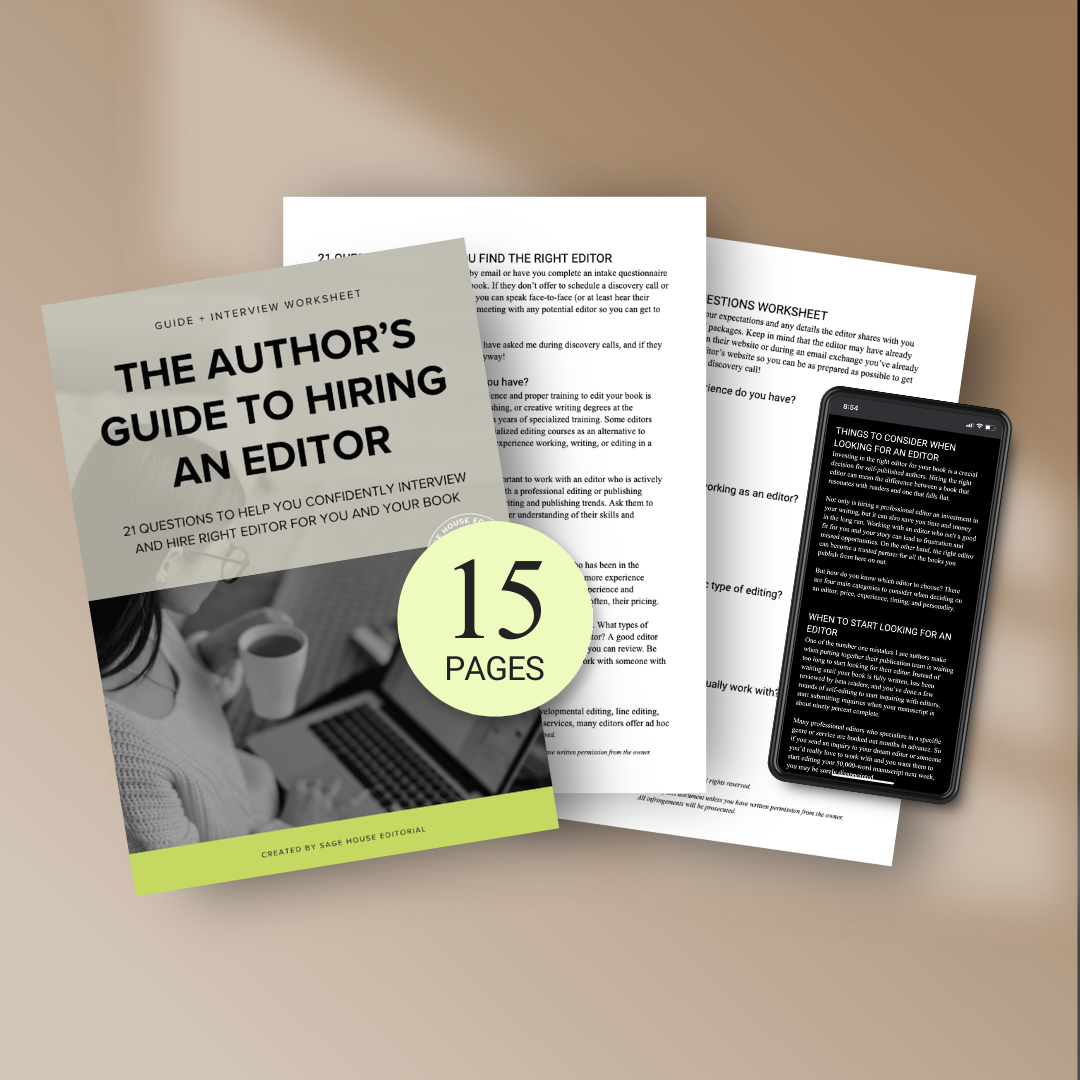
A good editor can explain the reasoning behind every suggestion she makes, respects your final say as the author, engages with your pushback thoughtfully, and makes your book more fully itself — not more like something she would have written. A bad editor imposes her preferences, makes changes without explanation, or returns your manuscript so altered it no longer sounds like you. The sample edit process exists precisely to let you assess this before you commit, and if you’re wondering how to find and hire the right editor for you and your book, I have a guide just for you.