How much does a book editor cost?
Original Article Published March 2023
If you've spent any time in entrepreneurial circles, self-publishing communities, or certain corners of the internet that shall remain unnamed, you've probably encountered the idea that you can get a full book edited for a few hundred dollars — or maybe even less if you find the right Upwork listing.
I want to talk about that. Not to shame anyone who's believed it — the information landscape around editing costs is genuinely confusing, and the people spreading the $500 book myth are often selling something — but because authors who are serious about their books deserve accurate information before they make one of the most significant investments in their publishing journey.
Let's look at what professional book editing actually costs, what drives those costs, and why the cheapest option almost always ends up being the most expensive one in the long run.
First: editing is not one thing
Before we can talk about cost, we need to talk about what you're actually buying — because "editing" covers a spectrum of distinct services with very different price points. What does a book editor actually do?
Developmental editing is the big-picture edit: structure, argument, narrative arc, chapter organization, whether the book is working for your reader. This is the most involved type of editing and typically the most expensive.
Line editing works at the sentence and paragraph level: clarity, flow, voice, prose quality.
Copyediting addresses the technical layer: grammar, punctuation, consistency, style guide adherence.
Proofreading is the final quality assurance pass before publication, verifying that the manuscript is clean and consistent.
These services happen in sequence, not simultaneously. Most nonfiction authors need all of them. And they each have their own cost.
For this article, I'm primarily focusing on copyediting and line editing costs — but I want you to build a publishing budget that accounts for the full editorial process, not just one phase of it.
What professional book editing actually costs
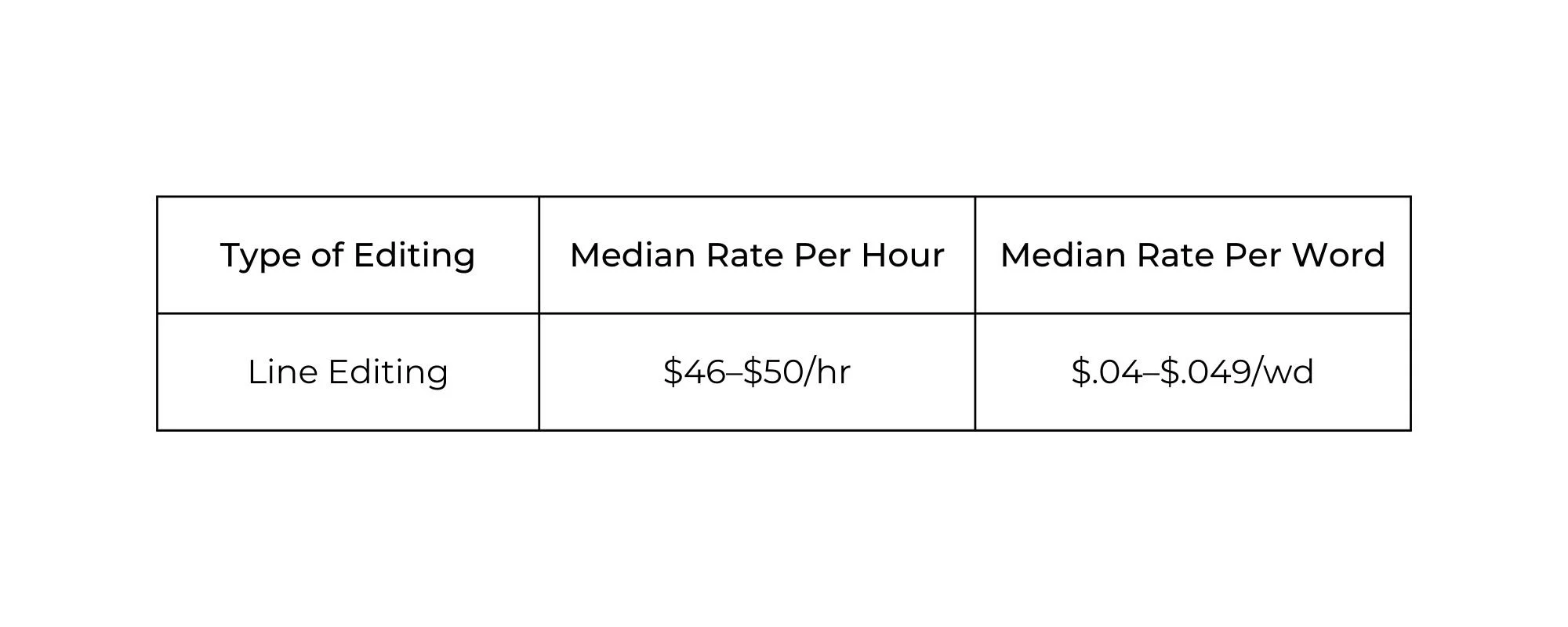
The most reliable industry data on editorial rates comes from the Editorial Freelancers Association (EFA), which surveys its members annually. Their 2026 rate chart — based on 2025 data from over 1,100 respondents — gives us the clearest picture of current median rates across the industry.
Here's what that data shows for nonfiction books:
Developmental editing: $0.045–$0.075 per word Line editing: $0.040–$0.060 per word Copyediting: $0.030–$0.040 per word (nonfiction) Proofreading: $0.020–$0.030 per word
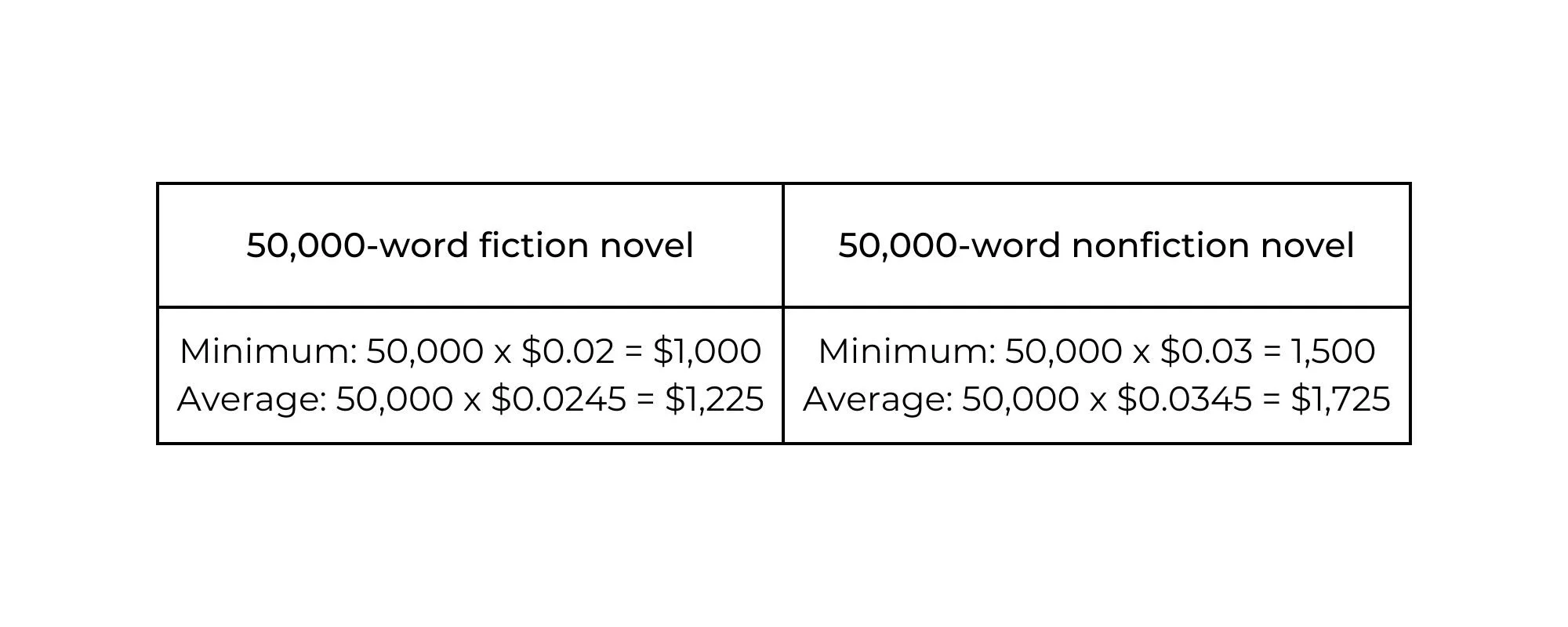
For a 60,000-word nonfiction manuscript — a reasonable length for a business or expertise book — that math looks like this at median rates:
Developmental editing: $2,700–$4,500 Line editing: $2,400–$3,600 Copyediting: $1,800–$2,400 Proofreading: $1,200–$1,800
Full editorial process, median range: $8,100–$12,300
I know. Take a breath.
Before you close this tab, let's talk about what those numbers mean — and what they don't.

What "median" actually means
This is the part that gets lost in most of the cost articles you'll find online: median rates represent the middle of a very wide range. They're not a ceiling, and they're not a floor.
The EFA is explicit about this in their own documentation: individual editors' rates vary considerably based on experience, expertise, specialization, local cost of living, and turnaround time. A developmental editor who specializes in nonfiction business books for thought leaders is not charging the same rate as someone who recently completed an editing certificate program and is building their portfolio. Both are counted in that median.
Reedsy, which operates a marketplace for editorial services, reports average rates from their platform at around $0.027 per word for copyediting. Their data skews lower because their marketplace model incentivizes volume and price competition.
None of this is wrong information. It's just incomplete without context — and that missing context is what sends authors toward decisions that cost them more in the long run.

The myth of the $500 book edit
Let's address this directly.
There are courses, programs, and content creators — particularly in the self-publishing-as-business-strategy space — who will tell you that a full book edit should cost you no more than $500. Some put that number even lower. The framing is usually something like: "I had my whole book edited for $300, and you can too."
What they don't tell you is what they actually got for $300. And more importantly, what they didn't get.
A $500 book edit is one of the following things:
A proofreading pass only — not a copyedit, and certainly not developmental or line editing. This is the equivalent of putting a coat of paint on a house with a cracked foundation.
Work done by someone who is new to editing, undercharging to build a portfolio, or using AI-assisted tools to get through your manuscript quickly. These are not inherently evil, but they are not the same as experienced, specialized editorial work.
Something that used to cost more and hasn't kept up with inflation, skills, or market rates — which often means you're working with someone who is undervaluing their own services or cutting corners to stay competitive.
I say this with zero judgment toward the authors who've gone this route and zero judgment toward editors who are early in their careers. But the ecosystem that tells you $500 is a reasonable budget for editing a book you've spent years writing is the same ecosystem that tells you you can write a book in 30 days and publish before the trend dies. Stop trying to write a book in 30 days. It is not interested in your book. It's interested in selling you something.
Four factors that actually drive editing costs
Understanding what moves the price up or down helps you budget accurately and make smarter decisions when comparing editors.
Type of editing. As I outlined above, developmental editing costs more than line editing, which costs more than copyediting, which costs more than proofreading. The more involved the service, the higher the price — and rightly so.
Manuscript length. Most editors price per word or per project. Longer books cost more to edit. A 40,000-word book will cost roughly half what an 80,000-word book costs at the same per-word rate. Knowing your word count before you reach out to editors gives you much more accurate quotes.
Editor experience and specialization. This is the biggest variable in editorial pricing — and the one most worth understanding. An editor who has spent ten years working exclusively on nonfiction books in your category, who understands your reader, who knows what works in your genre and what doesn't, is going to charge more than a generalist who edits across multiple formats. That premium reflects real expertise that has a direct impact on your book. How to hire a book editor
Timeline. Rush projects cost more. Editors who are booked out months in advance generally don't need to discount. If you reach out to an editor with a tight deadline, you should expect to pay rush rates — or to accept that your first-choice editor may not be available.
The ROI question you should actually be asking
Your book is a business asset. Edit it like one.
Here's the reframe that changes everything for authors who are approaching editing as a cost center rather than an investment.
If you're writing a nonfiction book as a thought leader, entrepreneur, or expert — and you should be thinking about it this way — your book is a business asset. It is a product. It carries your name and your brand into rooms you're not in, to readers you haven't met, to clients who will decide whether to hire you based in part on whether your book gave them confidence in your thinking.
That means editing is not just about whether your manuscript is technically clean. Good editorial work — specifically, the kind done by an experienced nonfiction editor who understands positioning, audience, and the architecture of a persuasive argument — is doing several things simultaneously:
It's making sure your ideas flow with coherence and momentum, not just in individual sentences but across chapters and through the whole arc of the book.
It's verifying that your argument is airtight — that your claims are supported, your logic holds, and your reader isn't left with unanswered questions that erode their trust in you.
It's checking that your positioning is clear — that a reader who has never heard of you understands exactly who you are, why you're the right person to be writing this book, and what they're going to get out of reading it.
It's making sure the reader is centered as the protagonist of the transformation your book offers — that you're functioning as the guide, not the hero — which is one of the most common structural problems in nonfiction books written by experts who are very close to their own material.
None of that is Grammarly. None of that is spell check. None of that is your colleague who has a really good eye for typos and got an A in AP English.
When you hire an experienced nonfiction editor, you are hiring someone whose entire professional orientation is toward strategic critical thinking about how books for your audience and your market need to be structured and written to work. That expertise is what you're paying for. That's also why the rates are what they are — and why "I found someone who will do it for $500" is not the win it sounds like.
The conversion math that changes the whole conversation
Let's be honest about something that most publishing advice dances around: if you're writing a nonfiction book as a business asset, you are probably not going to make significant money on book sales alone.
That is not a pessimistic statement. It's a realistic one that actually makes the editing investment easier to justify.
Your book's job is not primarily to generate royalty income. Its job is to establish your authority, attract the right readers, and convert some of those readers into clients, customers, speaking invitations, consulting relationships, or whatever the next step in your business looks like.
So the question to ask is not "how do I spend the least on editing?" It's: how many client conversions do I need to recoup my editorial investment?
If you work with coaching clients at $5,000 engagements, you need two new clients who found you through your book.
If you offer a $10,000 consulting package, you need one.
If you run a mastermind at $3,000 per participant, you need three.
A well-edited book that positions you clearly and persuasively, that gives your ideal reader confidence in your thinking, that converts browsers into buyers and readers into clients — that book can generate those conversions for years. A poorly edited book that undermines your authority, loses readers in unclear arguments, or positions you as just another voice in a crowded space cannot do that work, no matter how good your ideas are.
The editing investment that makes your book a credible, conversion-worthy asset is not overhead. It's the engine. Will AI replace editors?
So what should you actually budget?
Here's my honest, practical answer for nonfiction authors who are serious about their books:
For a full editorial process (developmental editing, line editing/copyediting, and proofreading) on a nonfiction manuscript of 50,000–70,000 words, budget somewhere between $8,000 and $15,000 for experienced, specialized editorial work.
That range will feel shocking to some of you. It felt shocking to me when I first encountered it as a new editor trying to understand the market. But it's an accurate reflection of what skilled nonfiction editing actually costs when you're working with people who are good at it and who understand your category.
If that number is genuinely out of reach right now, here are smarter ways to approach a tighter budget:
Phase your editorial investment. You don't have to do everything at once. Start with a manuscript assessment or a developmental edit to identify the structural issues, revise based on that feedback, and budget for copyediting and proofreading as a second phase.
Prioritize editorial over everything else. If you have $5,000 for your entire publishing budget and you're trying to choose between editing and a cover designer, choose editing. A beautiful cover on a poorly edited book is a beautiful envelope around a broken letter.
Do your self-editing work first. The cleaner your manuscript is before it reaches an editor, the more efficiently she can work — and in some cases, that translates to lower cost. What does a book editor actually do?
Ask about payment plans. Many independent editors will work with you on phased payments, especially for longer engagements. It doesn't hurt to ask.
Whatever you budget, do not choose your editor based primarily on price. Choose based on experience, specialization, process, fit, and the evidence of their work — and then let price be the final filter. How to hire a book editor
FAQ
How much does it cost to hire a book editor? For professional editing of a nonfiction book, expect to invest $8,000–$15,000 for a full editorial process (developmental editing, copyediting, and proofreading) with an experienced editor who specializes in your category. Individual phases cost less: professional copyediting alone typically runs $0.030–$0.040 per word for nonfiction at median rates, per the EFA's 2026 rate chart. Experienced and specialized editors charge more than median.
Why does professional book editing cost so much? Editing is skilled, time-intensive professional work that requires specialized expertise. A copyeditor working through a 60,000-word nonfiction manuscript may spend 60–100 hours on that project. Experienced editors who specialize in specific genres or categories bring knowledge that directly affects the quality of the final book — and that expertise is what you're paying for. The question isn't why editing costs what it costs; it's whether the investment serves your goals as an author.
Can I get a book edited for $500? For $500, you can get a proofreading pass on a short manuscript, work from an editor who is new to the field and building their portfolio, or something that is called editing but does not represent the full scope of professional copyediting or developmental work. Experienced, specialized editorial work costs significantly more — and for authors building books as serious professional assets, the difference in outcome is significant.
What's the cheapest type of book editing? Proofreading is the least expensive phase of editing, typically running $0.020–$0.030 per word. However, proofreading is the final quality assurance pass — it cannot substitute for copyediting or developmental editing, which happen earlier in the process. Skipping earlier phases and only proofreading is like cleaning the windows on a house that hasn't been repaired.
How do I budget for book editing? Start by understanding your manuscript's word count and which types of editing you need (developmental, line, copyediting, proofreading). Use the EFA rate chart as a baseline for median rates, and add a buffer for experienced or specialized editors who charge above median. Build your budget before you start reaching out to editors so you're comparing quotes with a clear sense of what's realistic — and so availability doesn't force you into a decision your budget isn't ready for.
Is expensive editing worth it? For authors building books as professional assets — to establish authority, attract clients, generate speaking opportunities, or create a lasting body of work — the quality of editorial work has a direct impact on the book's ability to do those things. A poorly edited book undermines the authority it was meant to build. A well-edited book works for you for years. The ROI is difficult to calculate precisely, but the cost of a book that fails to land is almost always higher than the cost of editing it properly in the first place.
How do I know if an editor is worth their rate? Look for evidence of their work: a portfolio, client testimonials, the types of books they've edited and for whom. Ask about their process, what's included in their fee, and whether they'll provide a sample edit. A professional editor who is confident in the value of their work will be transparent about their pricing and process. If you're getting vague answers or pressure to commit before you have full information, pay attention to that. [link to "How to hire a book editor"]

READ MORE